Safety & Training
N95 Respirator Fit Testing for Clinical Placements and Care Settings
Confirm when occupational fit testing is required, how to prepare, what happens during the appointment, and which model-specific record to submit.
Confirm whether fit testing applies to your role
An occupational fit test is required when an employer or placement determines that a tight-fitting respirator, such as a disposable N95, is needed to protect the wearer from an identified hazard. A conventional medical or procedure mask is not a tight-fitting respirator, does not form the same type of facial seal, and cannot be fit-tested. The requirement should therefore come from the placement, employer, occupational health service, or respiratory protection program rather than from the job title alone.
In healthcare, a fit-tested and seal-checked N95 is used for specified Airborne Precautions, including entering the room of or caring for a person with signs, symptoms, or a diagnosis of active pulmonary or laryngeal tuberculosis. Public Health Ontario guidance applies across acute care, long-term care, clinics, pre-hospital services, and home health care. A child care or private caregiver job title does not automatically establish a fit-testing requirement; it applies when the organization’s risk assessment, infection-control direction, outbreak plan, or assigned duties require a tight-fitting respirator. Obtain the current instructions for your specific setting before booking.
Understand what an N95 fit test confirms
The N95 designation describes filter performance: “N” means the respirator is not resistant to oil, and “95” means a minimum filtration efficiency of 95% for the specified test particles. It does not confirm that every N95 will seal to every face. Fit testing evaluates whether one make, model, and size can achieve the required seal on an individual wearer under test conditions.
Fit testing is one part of a respiratory protection program. Public Health Ontario identifies a health assessment, fit testing, and training in correct use and seal-checking as required program elements for staff who must wear an N95. Complete any health questionnaire or occupational assessment requested before the appointment. If you have a condition or symptom that may affect your ability to wear a respirator safely, discuss it with the designated health professional or program administrator rather than relying on the fit test as medical clearance.
Book the correct fit-testing service
Fit testing must be conducted by a person competent in the selected qualitative or quantitative method. Testing may be arranged through a school, placement site, employer, occupational health department, or qualified private provider. Before paying for an appointment, confirm which method is accepted, whether the tester supplies respirators, and whether the requesting organization requires its own form or specific information on the record.
Ask which respirator models the workplace or placement actually stocks. If one has been assigned, take that unused respirator or follow the tester’s supply instructions. Passing with a different product may not meet the requirement because similar-looking N95 respirators can have different shapes, materials, and sealing characteristics.
Prepare for the appointment
The skin must be free of hair wherever the respirator sealing surface touches the face or neck. Facial hair outside the sealing area does not automatically prevent testing, but no hair can cross or interfere with the seal. Follow the tester’s shaving instructions and keep hair, facial jewelry, clothing, and other items away from the sealing surface.
Bring the required form, the assigned respirator if instructed, and any identification requested by the provider. Wear or bring items that will be used with the respirator, including prescription glasses, protective eyewear, or other personal protective equipment that could affect fit. Wear dentures during testing if they will be worn at work. For a qualitative test, follow the provider’s directions about eating, drinking anything other than water, smoking, vaping, or chewing gum before the appointment because the method depends on detecting a test agent.
Know what happens during the test
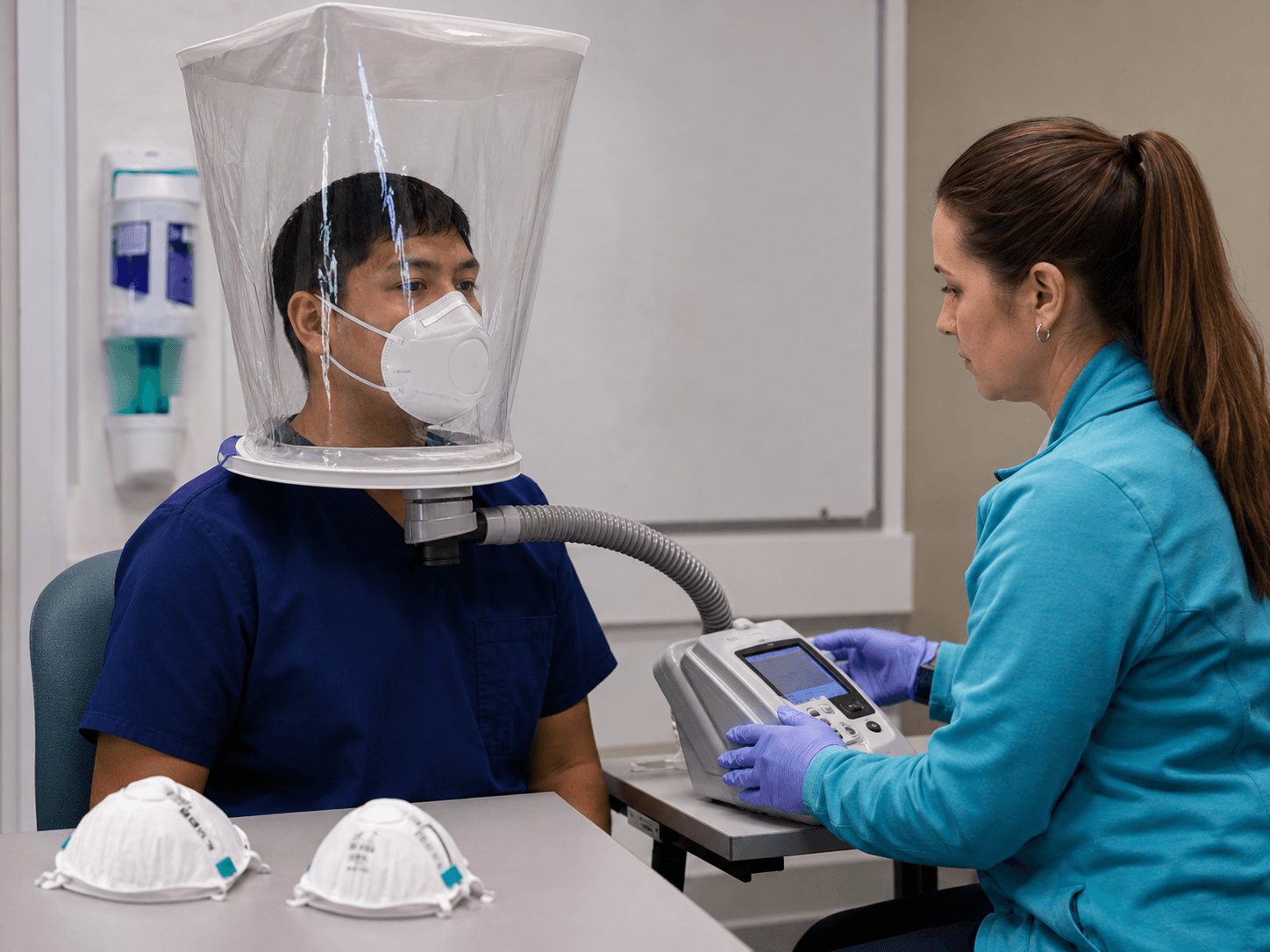
The tester will review eligibility, inspect the respirator, and assess comfort before teaching or confirming correct inspection, donning, adjustment, and user seal-check technique. While wearing the respirator, you will complete standard exercises that simulate use, such as regular and deep breathing, turning or moving your head, and speaking or reading aloud. The respirator must remain secure and comfortable throughout the protocol.
A qualitative fit test is a pass-or-fail test based on whether the wearer can detect a test agent, commonly a sweet or bitter aerosol, after first completing a sensitivity screen. A quantitative fit test uses an instrument to compare particles inside and outside the respirator and calculates a numerical fit factor. The quantitative method does not depend on taste or smell. The tester selects a method permitted for the respirator and level of protection required.
Use the result correctly and address a failed test
A pass applies only to the respirator identified on the fit-test record. Check the manufacturer and model markings each time the product is issued, inspect it for damage, put it on according to the manufacturer’s instructions, and perform a user seal check every time. A seal check confirms how the respirator was put on at that moment; it does not replace periodic formal fit testing.
If a test fails, do not use that respirator for work requiring respiratory protection. The tester may review the donning technique and then try another size or model. Do not modify the respirator to force a pass. When facial hair, facial features, or another barrier prevents a reliable tight seal, the requesting organization must assess an appropriate alternative. Ontario guidance identifies a loose-fitting powered air-purifying respirator as one possible option that does not require fit testing, but it must be selected through the organization’s respiratory protection and accommodation process.
Repeat testing when validity or fit changes
Public Health Ontario and the Canadian Centre for Occupational Health and Safety advise repeating fit testing at least every two years. An organization may set a shorter validity period, so a date accepted by one site may not satisfy another. Check the required completion window before scheduling and retain previous records for future reference.
Retest sooner when changing to a different respirator make, model, or size, or when physical changes could affect the seal. Relevant changes include substantial weight change, facial surgery, dental work that changes facial structure, scarring, new dentures, significant discomfort, or personal protective equipment that interferes with fit. Report a new problem obtaining a seal instead of waiting for the certificate to expire.
Submit a complete fit-test record
The record should show your full name, test date, tester’s name, qualitative or quantitative method, result, and the exact respirator manufacturer, model, and size. Depending on the method, it may also identify the testing organization, test agent or instrument, pass criteria, personal protective equipment worn during testing, restrictions, and any fitting difficulties. Review the document before leaving so an omission can be corrected by the tester.
Upload the complete, readable record to the matching CareCard requirement and keep the original. CareCard can guide the submission and support document validation, while the program, placement, or employer remains responsible for deciding which respirator, testing method, recency period, and evidence it accepts. A certificate for a different product or an incomplete result can delay clearance even when the appointment was completed.
Official N95 respirator resources
Use the current placement, employer, occupational health, and respiratory protection instructions together with these official references.
- CareCard preparation and upload guide
- Ontario guidance on masks and respirators in the workplace
- Ontario guidance on respirators and facial hair
- Ontario personal protective equipment fit requirements
- Public Health Ontario routine practices and additional precautions
- CCOHS respirator fit-testing guidance
- CCOHS guidance on wearing and seal-checking a respirator
- Health Canada medical mask and respirator information