Healthcare
TB Screening for Clinical Placements and Care Settings
Understand how Ontario TB screening requirements differ by setting, how to complete a two-step TST or IGRA, and which records to submit for review.
Confirm the requirement for your setting
Canadian guidance recommends baseline TB screening for healthcare workers. The baseline includes an individual risk assessment, a symptom review, and a tuberculin skin test for people without documented previous TB disease or TB infection. In Ontario hospitals, surveillance policies apply to people carrying on activities in the hospital, including employees, students, trainees, contract workers, researchers, and volunteers. The institution or occupational health department determines the form, deadline, and accepted test pathway.
Requirements outside hospitals are not identical. Ontario child care centres and home child care agencies must follow health-assessment directions from their local medical officer of health; Toronto currently recommends a TB risk assessment for child care staff, with testing when a healthcare professional determines it is needed. Long-term care and retirement-home staff are screened under evidence-based workplace practices, but legislation does not prescribe one test method. Home-care and private caregiver requirements depend on the employer, client setting, and local public-health policy. Obtain the exact instructions before booking a test.
Understand what TB screening can determine
A tuberculin skin test (TST) and an interferon-gamma release assay (IGRA) measure the immune response to Mycobacterium tuberculosis. They can identify evidence of TB infection, but neither test can distinguish latent TB infection from active TB disease. A person with latent infection has no symptoms and cannot transmit TB. Active disease affecting the lungs or throat can be infectious and requires clinical and public-health management.
Anyone with a persistent cough, fever, night sweats, unexplained weight loss, or a known recent exposure should contact a healthcare provider or occupational health service promptly instead of relying on routine clearance screening. Public health coordinates testing when a person is identified as a contact of an infectious TB case.
Complete a two-step TST correctly
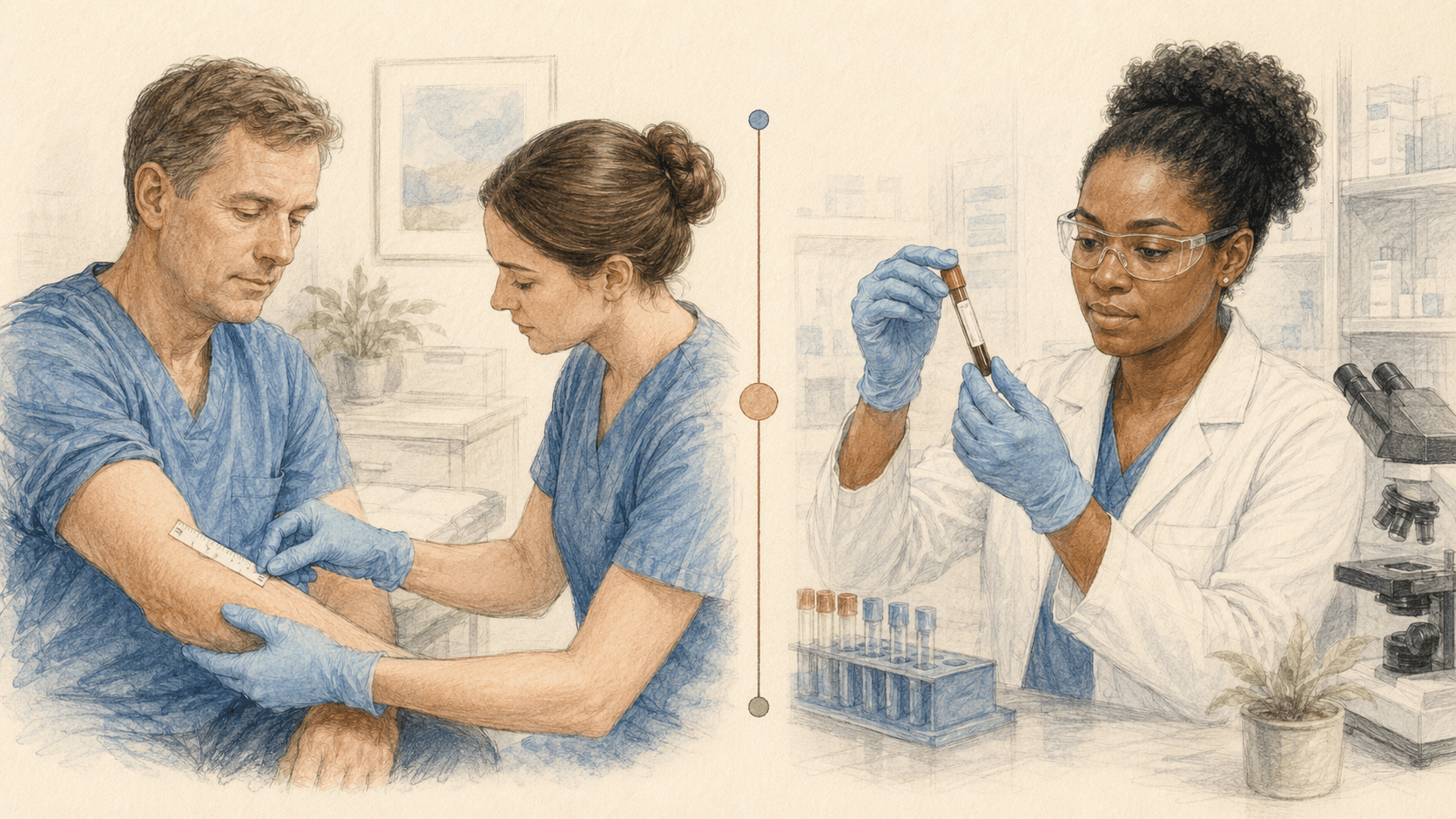
For a TST, a trained healthcare professional injects purified protein derivative just under the skin of the forearm. You must return 48 to 72 hours later to have the firm swelling, called induration, measured in millimetres. Redness is not measured, and the result must be read by a trained professional. If the test is not read within the required window, it must be repeated.
When a two-step baseline is required and the first result is negative, the second TST is placed one to four weeks later and is also read 48 to 72 hours afterward. If the first test is positive, the second step is not completed; medical follow-up is required instead. Plan for as many as four appointments. A documented two-step baseline is normally completed once, and later routine TSTs are single-step tests. This process is different from post-exposure testing, which may require another test at least eight weeks after the last exposure.
Use an IGRA when it fits the requirement
An IGRA is a laboratory blood test that measures interferon-gamma released when blood cells are exposed to TB-specific antigens. It requires one blood collection and no return visit for a skin reading. BCG vaccination does not affect the result. Canadian guidance prefers an IGRA in several situations, including when BCG was given after infancy or more than once, when the timing of BCG is uncertain, when a person is unlikely to return for a TST reading, or when TST is contraindicated.
Confirm that the program or employer accepts IGRA before paying for it. Toronto Public Health reports that QuantiFERON-TB Gold is available in Ontario and is not currently covered by OHIP. An indeterminate or invalid result does not establish TB status and generally requires a repeat test or an alternative selected by a healthcare provider.
Review timing and medical history before testing
Tell the testing provider about any previous positive TST or IGRA, previous TB disease or treatment, a severe blistering TST reaction, current major viral illness, extensive burns or eczema at possible injection sites, recent live-virus vaccination, pregnancy, and medications or conditions that affect immunity. Bring any previous TB test, chest X-ray, or treatment records so the provider can select the appropriate assessment.
A TST can be given before or on the same day as a live-virus vaccine at a different site. Otherwise, Canadian guidance recommends waiting four weeks after vaccines such as measles, mumps, rubella, varicella, or yellow fever because they may produce a false-negative result. Pregnancy and breastfeeding are not contraindications to TST. A healthcare professional should determine whether immune suppression could affect test selection or interpretation.
Complete follow-up after a positive result
A positive TST or IGRA requires medical evaluation to rule out active TB disease. The assessment normally includes a symptom and risk review and a chest X-ray; sputum testing or other investigations may be required when symptoms or imaging findings suggest pulmonary TB. Once a properly performed test has been confirmed as positive, repeating TST or IGRA has no clinical value. The clinician may recommend preventive treatment after active disease has been excluded.
A positive infection test does not automatically exclude someone from work or placement. A person with infectious TB disease may need to remain away from the setting until the treating clinician and public health determine that the person can return safely. Routine annual chest X-rays are not recommended after active disease has been ruled out; repeat imaging is generally reserved for new symptoms or a relevant exposure.
Submit complete evidence and maintain your baseline
For a two-step TST, submit a provider record showing your full name, the administration and reading dates for both steps, each result in millimetres of induration, and the provider information. For an IGRA, submit the original laboratory report with the result clearly stated. If you have a previous positive result, provide that record together with the requested chest X-ray report, medical clearance, and treatment documentation when applicable.
Routine annual TST or IGRA testing is not recommended for every worker with a negative baseline. An organization may require additional screening for roles with higher occupational exposure risk, after a recognized exposure, or under a site-specific policy. Keep the original baseline and follow-up records, then upload them to the matching CareCard requirement so the reviewer can validate the evidence without requesting missing details.
Official TB screening resources
Use the current program, employer, occupational health, and local public-health instructions together with these official references.
- CareCard tuberculosis skin test requirement guide
- Canadian Tuberculosis Standards: diagnosis of TB infection
- Canadian Tuberculosis Standards: healthcare settings
- Ontario Tuberculosis Program Guideline
- Toronto Public Health workplace TB screening recommendations
- Ontario child care health and medical supervision guidance
- Ontario hospital communicable disease surveillance guidance